Apartment Building Roofing in New York
Trusted apartment building roofing in New York, NY. Licensed roofing company, free estimates, quality workmanship. Call (917) 440-1800.
Our crews work out of our office right here in New York and take on projects across New York.
Pre-war co-ops and post-war apartment blocks across Manhattan share a roofing problem that newer construction rarely sees: a flat or low-slope roof carrying decades of patched asphalt, a parapet wall that was never flashed to current standards, and a bulkhead housing the elevator motor room that penetrates the membrane in at least two places. On buildings near Chelsea and Greenwich Village, we routinely find all three issues on the same roof, sometimes layered under three or four prior re-roofing attempts.
Why New York Properties See Apartment Building Roofing Issues
Most multifamily buildings in Manhattan were built between 1900 and 1960, long before today’s membrane systems existed. Tar and gravel built-up roofing was standard for decades, and a lot of it is still up there, patched instead of replaced because access is difficult and tenants can’t be displaced for a full tear-off. Add in rooftop mechanical equipment, satellite dishes, and shared terraces that co-op boards approved informally over the years, and you get a roof surface with dozens of penetrations that were never properly detailed. Winter freeze-thaw cycles work into every one of those gaps, and the parapet walls common on pre-war buildings in Tribeca and the Lower East Side trap water against brick that wasn’t built with a modern cap flashing in mind. Roof drains clogged with debris from nearby street trees are another recurring cause of ponding on buildings near Central Park and the Upper West Side, where mature tree canopy sheds heavily each fall.
Our Apartment Building Roofing Process in New York
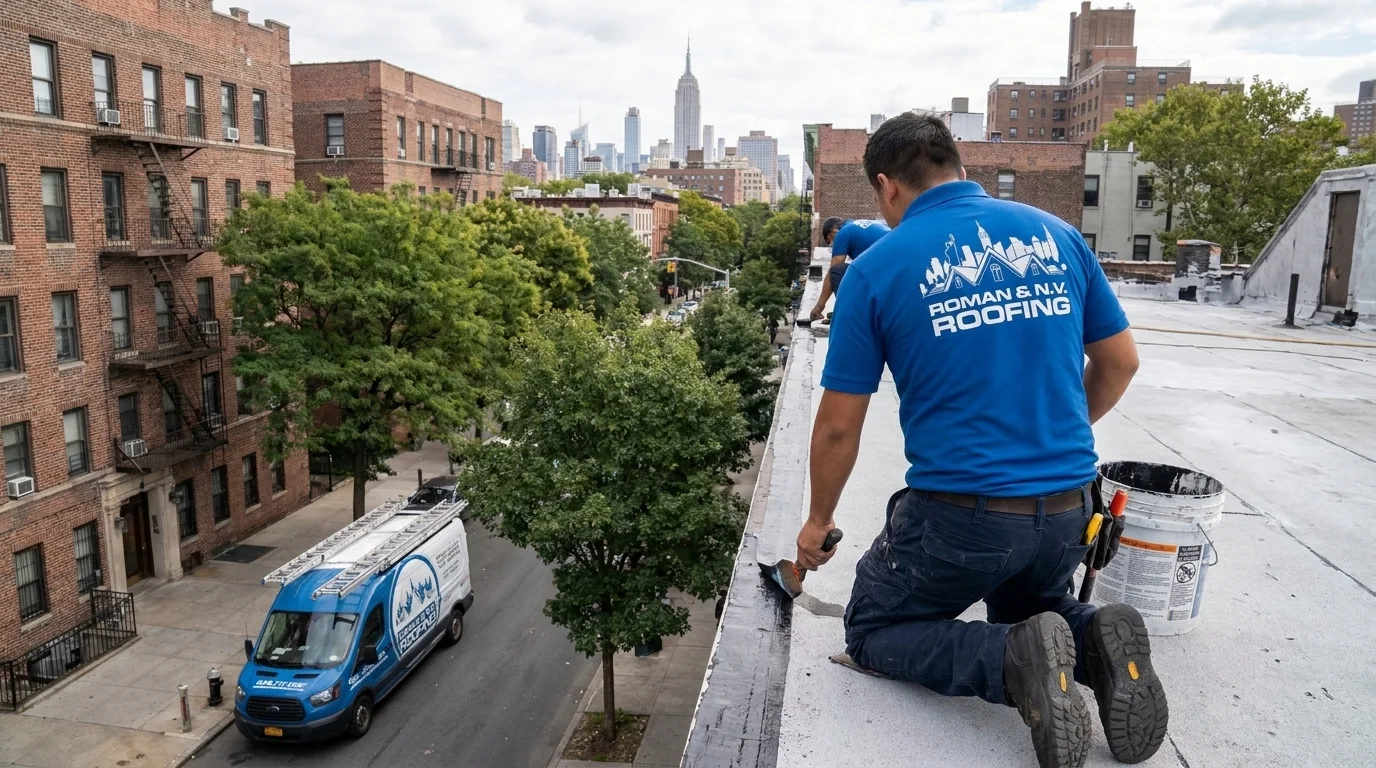
Work on an occupied multifamily building starts with a walk of the full roof deck, not just the obvious trouble spot, because a leak reported in a top-floor unit often traces back to a parapet seam or bulkhead flashing well away from that apartment. We document the membrane condition, drain locations, and any prior patch work, then put together a scope that separates repair from full replacement so the co-op board or managing agent can budget accordingly. For repair work, we isolate the section, strip back to sound substrate, and rebuild flashing details at penetrations before resealing the membrane. Full replacement on an occupied building means staging materials for a hoist or roof-access elevator rather than a ground-level dumpster, since most walk-ups and mid-rise co-ops near Midtown don’t have alley access for standard equipment. We coordinate material deliveries and crew access times with the superintendent so elevator use and lobby access stay predictable for residents during the job.
New York Insurance & HOA Coordination
Co-op and condo boards usually require a certificate of insurance and a scope letter before work starts, and most management companies want documentation that ties the roof work to the building’s capital reserve plan rather than an emergency special assessment. We work directly with property managers and board members to provide the paperwork they need for board meeting approval, and we’ve found that buildings carrying their own master insurance policy often need photo documentation of pre-existing damage before a claim gets filed, not after. If a storm or wind event causes damage, we document the specific area affected, which helps the board’s insurance adjuster separate storm damage from the general wear every older roof in the city carries.
Local note
Buildings in the 10011 and 10014 ZIP codes, covering much of Chelsea and the West Village, tend to share a quirk: many were converted from single-family rowhouses to multi-unit buildings decades ago, which means the roof often steps down across what used to be separate building footprints. That creates internal parapet walls and valley conditions that a standard flat-roof inspection can miss if the crew isn’t looking for the seam where two original buildings were joined under one roofline.
If your building’s roof is showing ceiling stains on a top-floor unit, standing water after rain, or visible wear at the parapet caps, it’s worth getting an inspection before the next board meeting rather than after the next leak. Roman NV Roofing works directly with co-op boards, condo associations, and property managers across Manhattan on both targeted repairs and full apartment roof replacement, and the OSHA-trained crew doing the work understands what occupied-building scheduling actually requires. Call (917) 440-1800 to set up a roof walk and get a scope written up for your next board review.
Serving New York from our New York office · ★ 5.0 · 168 Google reviews
“Storm damage left part of our Brooklyn roof in poor condition. Billy from Roman Local Law 11 NYC Restoration explained what needed to be addressed. The repair team worked carefully and restored the affected area.” — Sonia, October 2026Read our reviews on Google →
Apartment Building Roofing in New York: Service Coverage
Frequently Asked Questions
Do pre-war co-ops near Tribeca and the Lower East Side need different flashing details than newer apartment buildings?
Can apartment roof repair happen without displacing tenants in occupied buildings?
What does a co-op board need from us before approving a roof project?
Are buildings around 10011 and 10014 more likely to have roof-step or valley issues?
How do you handle roof drain and ponding issues on buildings near Central Park with heavy tree cover?
Apartment Building Roofing in New York
Our crews are based in New York, NY and take on projects across New York. Call for a free estimate.