Flat Roofing in New York
Trusted flat roofing in New York, NY. Licensed roofing company, free estimates, quality workmanship. Call (917) 440-1800.
Our crews work out of our office right here in New York and take on projects across New York.
Flat roofs cover most of Manhattan’s walk-ups, pre-war co-ops, and converted lofts, from Tribeca’s cast-iron buildings to the brownstone-lined blocks near Chelsea. These roofs carry parapet walls, bulkhead access points, and often a shared roof deck, which means a membrane failure doesn’t just leak into one apartment, it can travel across a party wall and show up two units over. Roman NV Roofing has worked on flat roofing systems across the city since 1987, and most calls start with a water stain that doesn’t match where the leak actually started.
Why New York Properties See Flat Roofing Issues
A lot of the flat roofing stock in neighborhoods like Greenwich Village and the Lower East Side (10002, 10014) dates to a building boom that predates modern membrane technology. Many of these roofs were built with tar and gravel or early modified bitumen, materials that age differently than anything manufactured today, and decades of patch jobs on top of the original system create uneven surfaces where water collects instead of draining to the scuppers. Add in rooftop mechanicals, satellite mounts, and water tank legs puncturing the membrane over the years, and a flat roof that looked fine from the street can have a dozen small failure points by the time a tenant reports a ceiling stain. Freeze-thaw cycles each winter widen any existing crack in flashing or parapet coping, which is why flat roof repair calls tend to spike after the first hard freeze and again during spring thaw.
Our Flat Roofing Process in New York
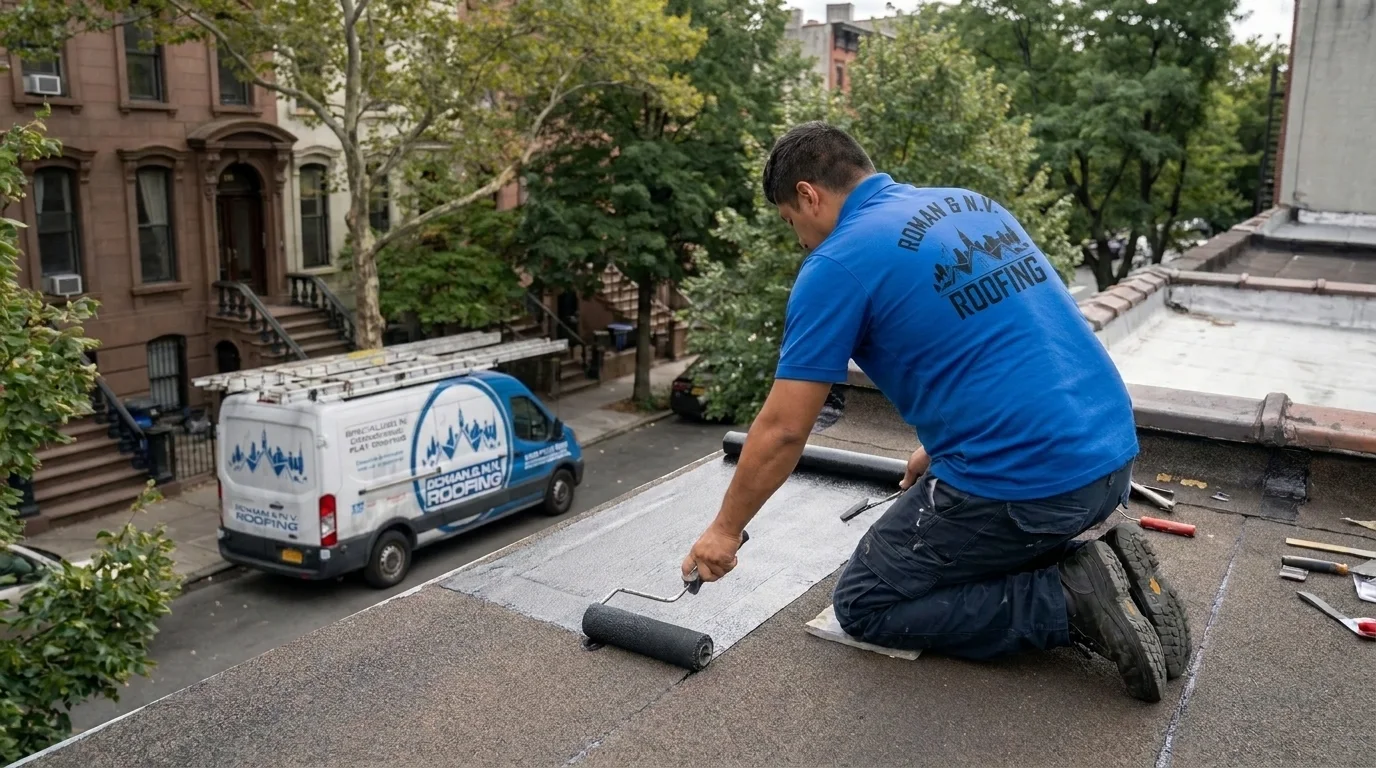
We start by walking the full roof, not just the area near the reported leak, since flat roofing problems rarely stay where they started. That includes checking parapet wall flashing, bulkhead seams, scupper drains, and any penetration for pipes, vents, or rooftop equipment. Depending on the building and the condition of the existing membrane, flat roof replacement typically means stripping down to the deck or, where the substrate allows it, installing a new membrane over a properly prepared existing surface. In Manhattan that process also means filing with the city’s Department of Buildings when the scope requires it, which is a step we factor into scheduling rather than treat as an afterthought.
Equipment & Methods We Use for Flat Roofing
Getting material onto a roof near Chelsea or the Lower East Side isn’t the same job as it would be with a driveway and a ladder truck. Many walk-ups don’t have freight elevators, so modified bitumen rolls and insulation board often go up by hand through narrow stairwells or get hoisted by rope and pulley from street level. We use heat-welded TPO on some low-slope commercial sections and torch-applied modified bitumen on others, choosing based on the deck condition, the building’s fire code requirements, and what the existing system will accept without a full tear-off. Flashing details around parapets and bulkheads get extra attention since those transitions are where most flat roofs actually fail, not the open field of the membrane itself.
Co-op and Condo Board Coordination
A large share of flat roofing work in Manhattan runs through a co-op or condo board rather than a single owner, and that changes the timeline more than the technical work. Boards typically want a certificate of insurance, a scope letter, and sometimes bids from more than one contractor before approving a flat roof replacement, especially on buildings near Midtown or Tribeca where the roof doubles as a shared amenity space or holds building mechanicals. We provide the documentation boards ask for up front so the approval step doesn’t stall a repair that’s actively letting water into the top floor.
Local note
Roof hatch access on pre-war buildings is usually a tight vertical ladder inside a locked bulkhead, not a walk-out door, and the building super often controls the only key. On jobs near Washington Square or the West Village we’ve learned to confirm hatch access and elevator availability with the building manager before a crew shows up, because losing an hour trying to get onto the roof costs more on a dense block than it would almost anywhere else in the five boroughs.
Whether you’re dealing with a slow leak on a Lower East Side walk-up or planning a full flat roof replacement for a co-op board near Chelsea, Roman NV Roofing handles the inspection, the paperwork, and the install. Call (917) 440-1800 to schedule a look at your roof.
Serving New York from our New York office · ★ 5.0 · 168 Google reviews
“Storm damage left part of our Brooklyn roof in poor condition. Billy from Roman Local Law 11 NYC Restoration explained what needed to be addressed. The repair team worked carefully and restored the affected area.” — Sonia, October 2026Read our reviews on Google →
Flat Roofing in New York: Service Coverage
Frequently Asked Questions
Are Greenwich Village and Lower East Side buildings more prone to ponding water on flat roofs?
Does New York's Department of Buildings require a permit for flat roof replacement in Manhattan?
What flat roofing materials hold up best on New York's pre-war buildings?
How do you get materials onto a flat roof in a walk-up near Chelsea or the Lower East Side?
How does a co-op or condo board affect scheduling a flat roof replacement in Manhattan?
Flat Roofing in New York
Our crews are based in New York, NY and take on projects across New York. Call for a free estimate.